
Your Health-Economic Model Is Not a Commercial Plan
Three gaps sit between the evidence you have and the case a payer, a provider, and a buyer will actually act on. Most early-stage SaMD, digital health, and diagnostics companies close one. Few close all three.
Writen by Nandy Thaver
7 September 2026
A founder walks into a payer conversation with a health-economic model that took months and real money to build. Cost-effectiveness ratio, budget impact, a trial dataset that holds up to scrutiny. The model is sound. The meeting still stalls.
The reason is rarely the evidence. It is what sits between the evidence and the room: no defined buyer, no price the market will bear, no narrative built for the person across the table, no plan for the weeks after the pathway is confirmed. A health-economic model proves a claim. It does not name a customer, set a price, or open a door. Those are commercial decisions, and they don't fall out of a spreadsheet.
The Three Gaps
Evidence, once generated, has to survive three separate translations before it becomes something a founder can use in front of a payer or a provider. Each translation is where most companies lose ground.
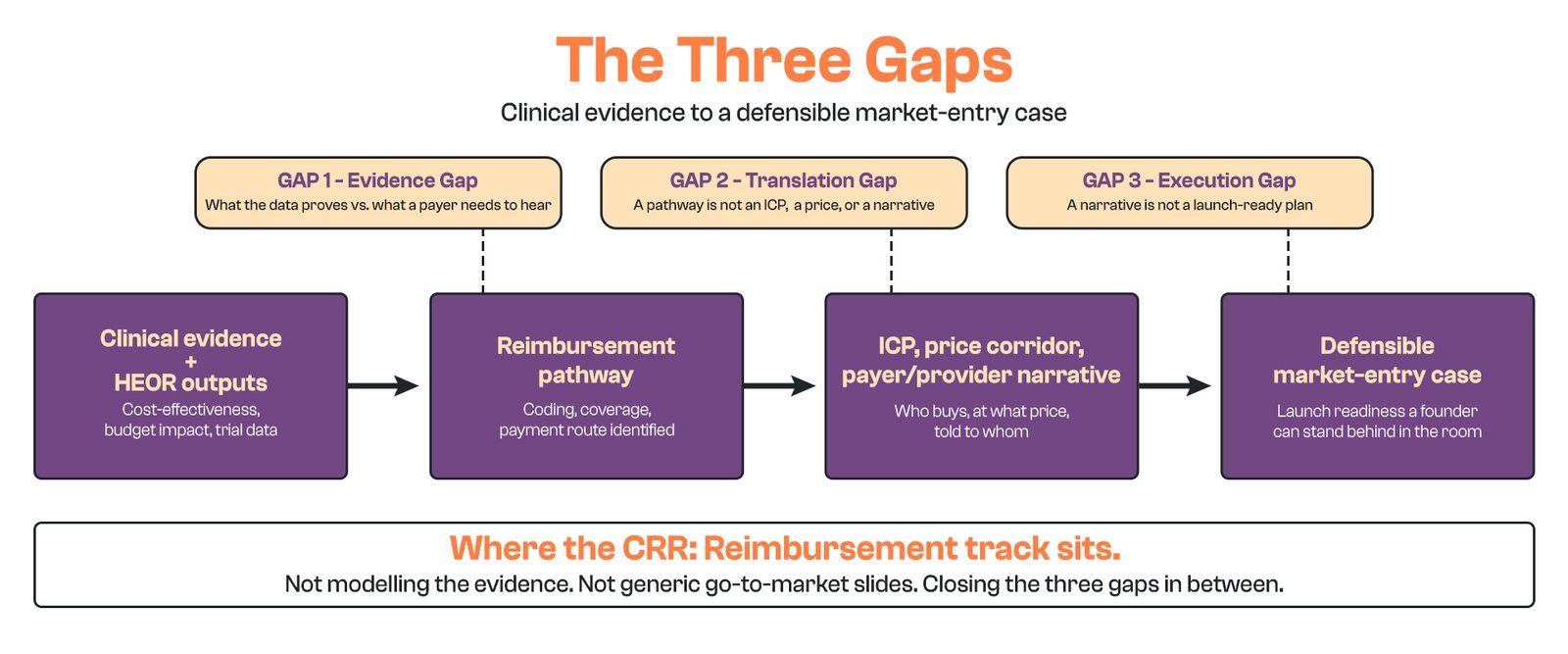
Gap 1 — The Evidence Gap
What the data proves and what a payer needs to hear are not the same statement. A cost-effectiveness result answers a modelling question. A payer is answering a budget question, a formulary question, a political one. Evidence that isn't reframed for that decision gets acknowledged and shelved.
Gap 2 — The Translation Gap
A confirmed reimbursement pathway tells you coding, coverage, and payment route exist. It does not tell you who the buyer is, what price the corridor will support, or how the story lands differently with a payer than with a provider. Companies that stop at "we have a pathway" still don't have a commercial case.
Gap 3 — The Execution Gap
A sharp narrative that never becomes a sequenced plan is a deck, not a launch. Founders need to know what happens in what order once the pathway is confirmed: who gets approached first, what the pilot looks like, what proof point unlocks the next conversation.
What Payers Actually Ask Early-Stage Founders
Strip away the jargon and payer questions repeat across geographies and categories. None of them are answered by a health-economic model alone.
"Who exactly is paying for this, and out of which budget line?"
Not the therapeutic area. The specific budget holder, and whether that holder has ever paid for something in this category before.
"What happens to the patient pathway if we say yes?"
A payer is buying a change in workflow, not a device or an algorithm. If the pathway shift isn't mapped, the evidence is answering a question nobody asked.
"Why this price, and compared to what?"
A number without a corridor invites a counter-offer. A number anchored to a comparator, existing spend, or an alternative pathway invites a negotiation.
"What do you need from us in year one versus year three?"
Founders who can only describe the ask at approval, and not the sequence after it, read as unready regardless of how strong the trial data is.
Closing the Gaps Is the Work
None of this argues the health-economic model doesn't matter. It argues that the model is one input into a market-entry case, not the case itself. A defensible market-entry case names the ICP, sets a price corridor the evidence can defend, builds the narrative separately for payer and provider, and lays out what launch-readiness looks like once the pathway clears. Skipping any one of the three gaps shows up later, usually in a room the founder can't afford to lose.
Thaver is the commercial translation layer between health-economic evidence and market execution for early-stage SaMD, digital health, and diagnostics companies.
The evidence proves the claim. Thaver builds the commercial case around it.