
White paper
After the First Cheque- Why early-stage biotech and healthtech startups win the next round on more than science
Fundraising & Transition Support
You raised your first round on a breakthrough. The next one will be harder, slower, and far more selective. In 2026, early-stage capital is scarcer than it has been in years, and it is reaching only the founders who turned their first cheque into real proof. This paper sets out what that proof looks like and how to start building it today.
What this whitepaper covers
- Why the early-stage funding market has tightened
- What investors actually fund in 2026
- How to make your first cheque count
Raising your first round feels like an arrival. In truth, it is a departure. The money does not prove the company works. It buys the time to prove it.
That distinction matters more in 2026 than it has in years, because the next round is no longer a formality. It is where many promising companies quietly disappear.
For a scientist-founder, this is an uncomfortable shift. The skills that produced the breakthrough are not the same skills that close the next round.
It is a trap precisely because it does not feel like one. The bank balance is healthy, the team is hiring, and the science is moving. The danger stays invisible until the runway runs low.
The Market Has Tightened, and It Has Changed
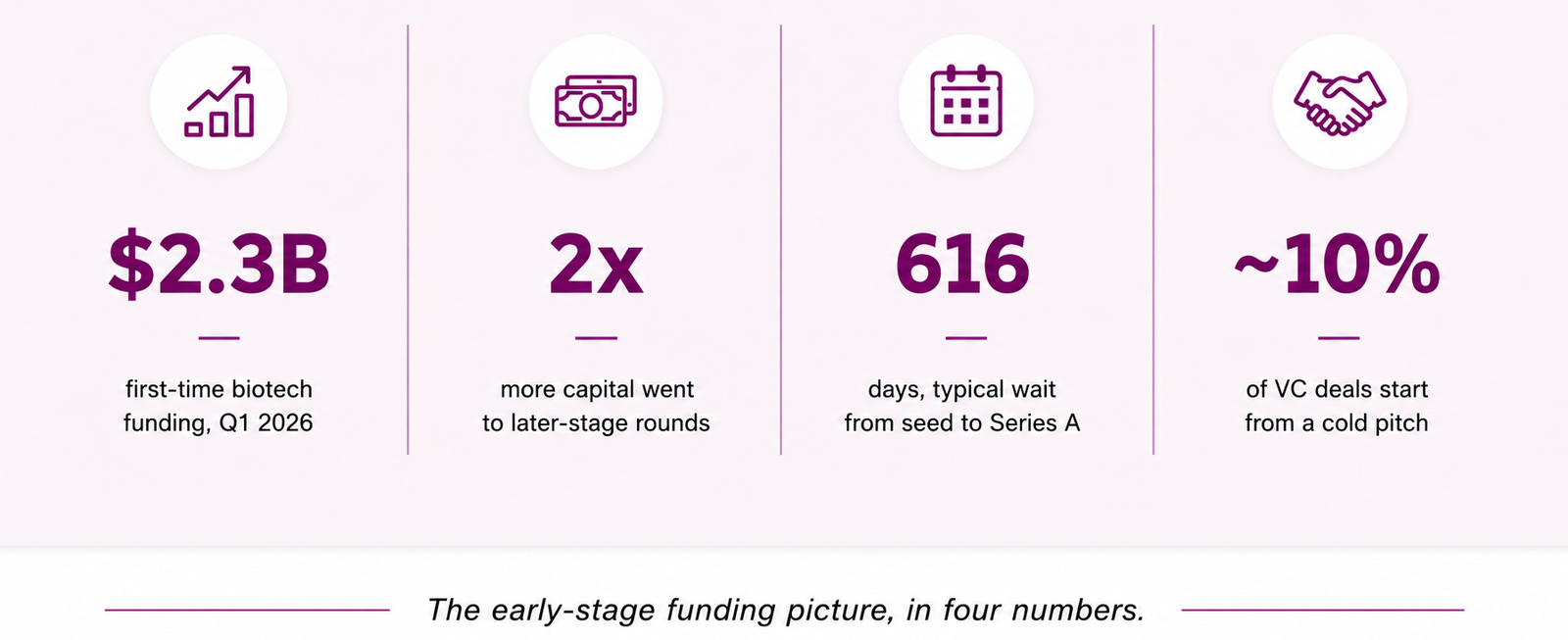
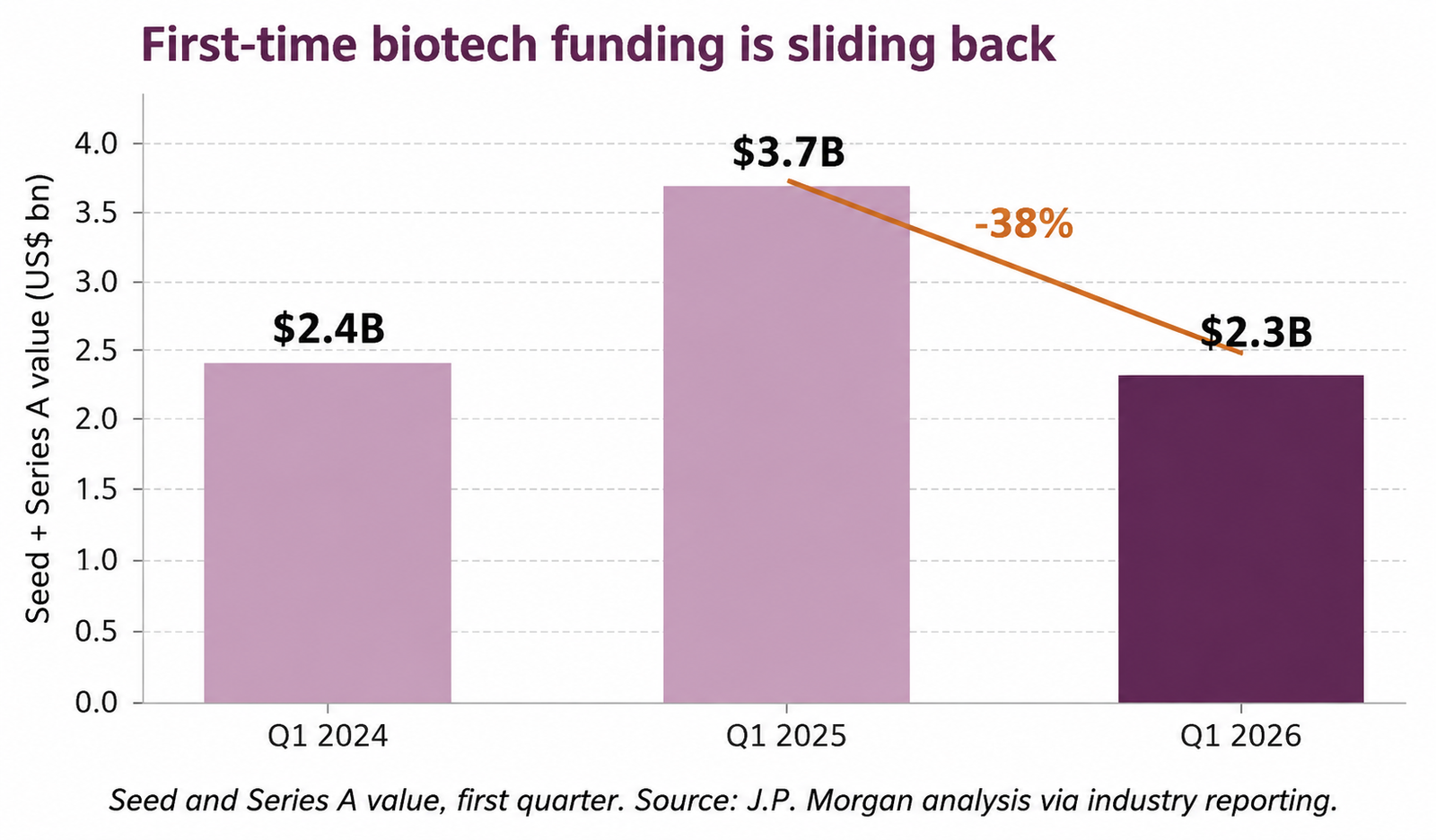
Early-stage biotech funding is sliding back toward a post-pandemic low. In the first quarter of 2026, seed and Series A companies raised about 2.3 billion dollars, down from 3.7 billion a year earlier.
The brief recovery of 2025 has faded. On current trends, the sector is heading for its lowest number of first-time financings this decade.
The money has not vanished. It has moved. In the same quarter, later-stage companies raised about 4.5 billion dollars, roughly twice the early-stage total.
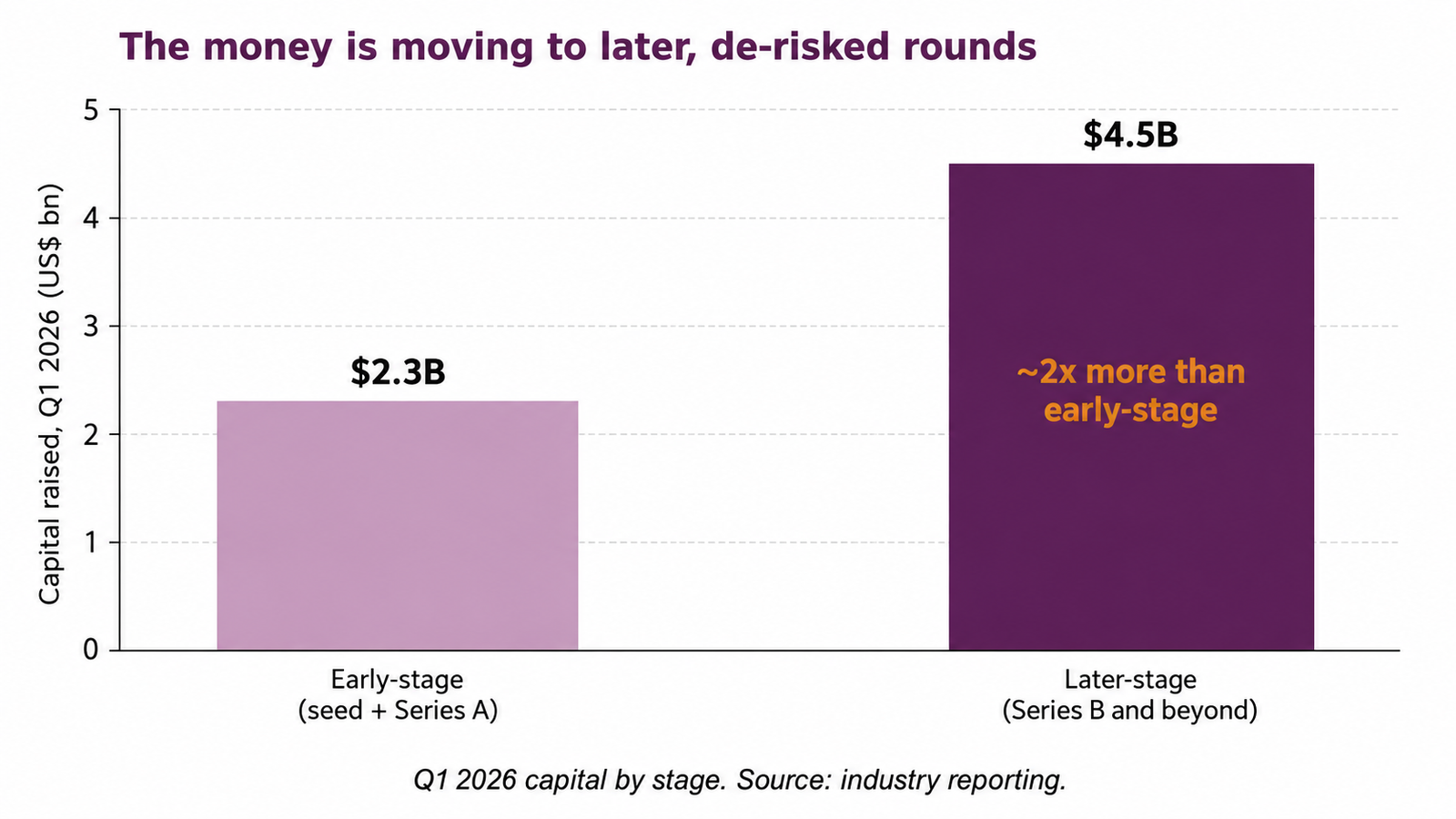
Investors are favouring businesses with established data, de-risked development, and near-term
catalysts. The gap between early and later-stage funding is widening.
The headline rounds are still large, but there are fewer of them, and they go to companies that have
already cleared the bar.
This is the tightest early-stage market most founders raising today have ever seen, and it rewards a very specific kind of company.
A breakthrough alone no longer guarantees a meeting, let alone a term sheet.
For founders, the message is uncomfortable but useful. The problem is rarely the science. It is the
distance between promising science and a fundable business.
Why First-Funded Startups Stall
The science got you the meeting. It will not, on its own, get you the next cheque.
Three forces catch founders out. Each is survivable on its own. Together, and unnoticed, they end
companies.
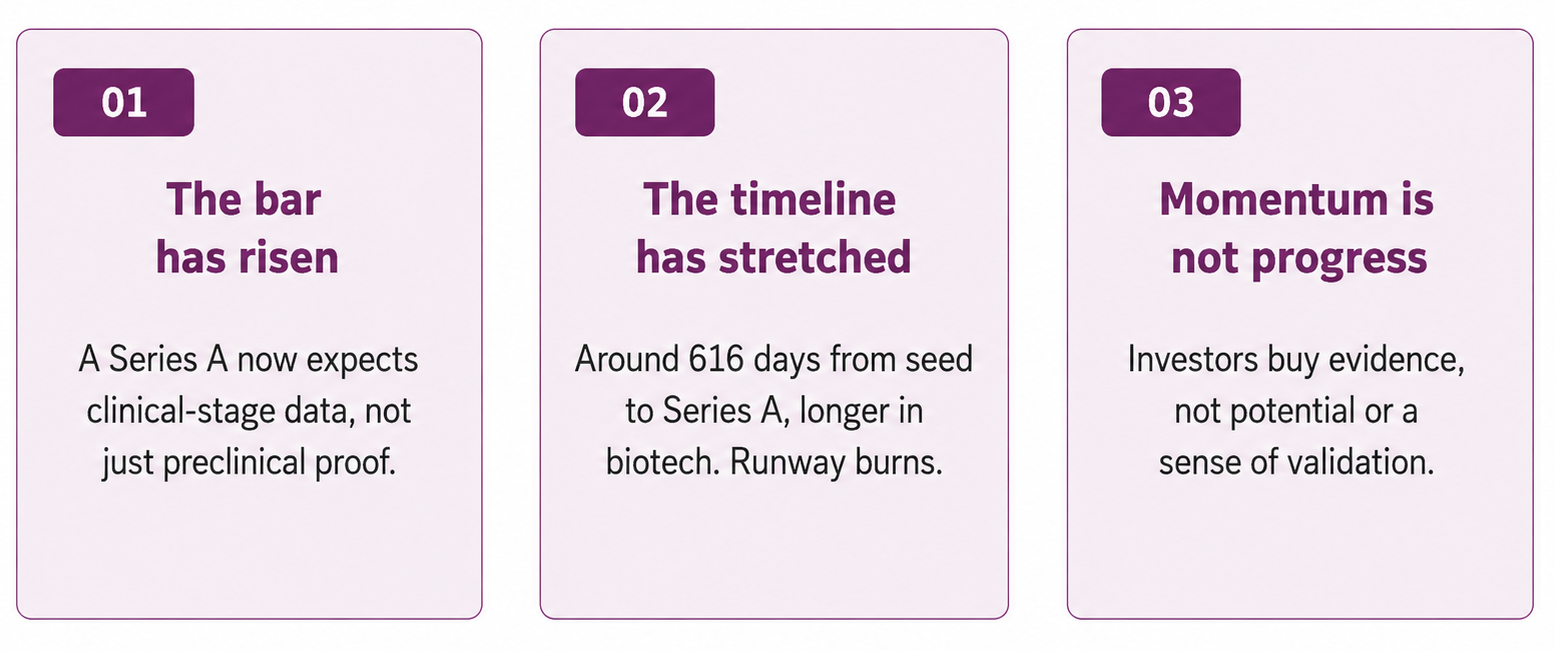
The three forces that stall first-funded startups.
Funding gaps, not failed experiments, are among the most common reasons early biotechs do not make it. Many run out of money while the science is still alive.
The most painful version is the company that raised on a great story, spent two years proving the
science, and arrived at the next round with no commercial evidence to show for it.
What Investors Actually Fund Now
A simple rule explains most outcomes. Scientific milestones get you the meeting. Operational readiness gets you through diligence. In 2026, that readiness has four parts.
- De-risking data. Evidence that moves the asset closer to the clinic and retires the biggest technical risk.
- A clean operating foundation. An orderly cap table, clear financials, and milestone costs that hold up under scrutiny.
- A market story. Who needs this, why now, and a credible route from science to revenue, not the size of the market alone.
- The right investors, reached the right way. Specialist healthcare funds, approached through warm introductions, since only about a tenth of deals begin with a cold pitch.
Investors are not looking for perfection. They are looking for a company that knows its risks and has a credible plan to retire them.
Think of it as the difference between a compelling story and a closeable deal. The four ingredients turn one into the other, and they also make a company easier to partner with later.
Two questions sit behind almost every diligence process. Has the biggest risk been reduced since the last round, and can this team turn money into milestones? Most else is detail.
A founder who can answer both, with evidence rather than optimism, moves to the front of a crowded queue.
Make the First Cheque Count
The founders who raise well treat their runway as a campaign, not just a research budget. The goal is not only to do the work but also to build the case for the next round as you do it.
Four moves make the difference, and none of them require slowing the science. They run alongside it, using the same months more deliberately.
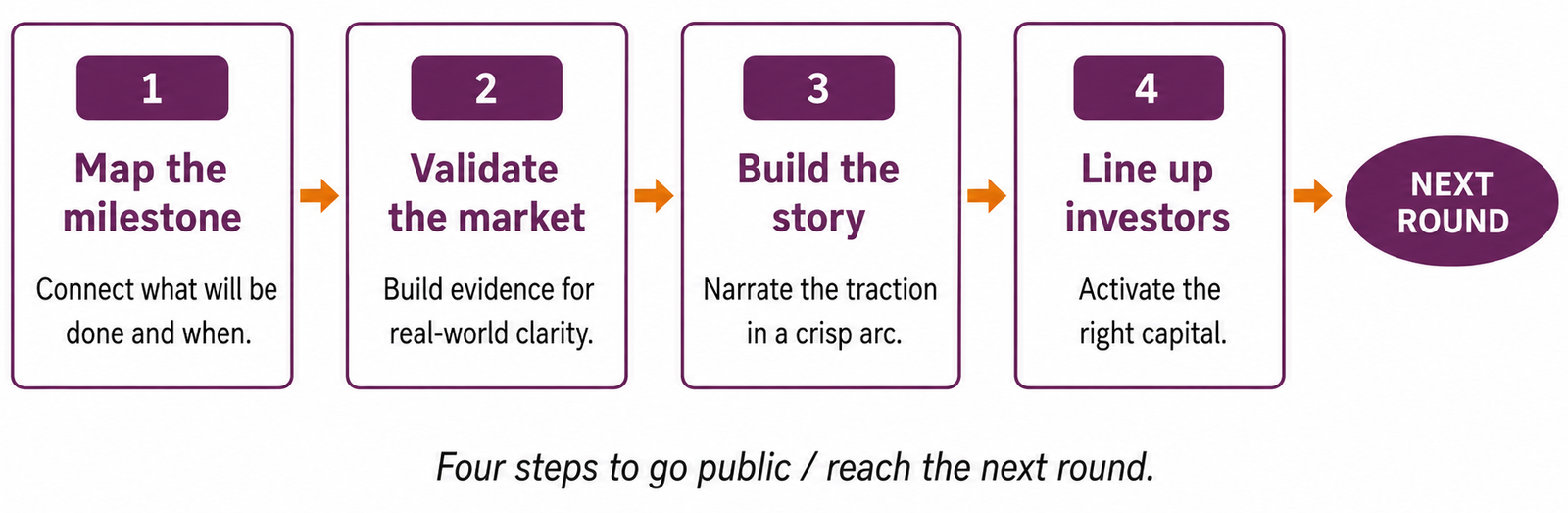
Done well, this turns fundraising from a scramble into a process. The story is ready, the data lands on schedule, and the right investors already know who you are.
Most early teams cannot hire a full senior commercial and operating bench to do this, and they should not have to.
Fractional, on-demand leadership brings that experience in at the stage it matters most, helping a founder package, position, and raise without a permanent hire.
Key takeaway.
The next round rewards preparation, not just brilliance. The work to win it starts the day the first cheque clears
The Next Round Goes to the Prepared
The market has not closed. It has become more honest about what readiness means.
Founders who understand this raise faster and on better terms. Those who wait risk running out of runway with strong science and no second cheque. Market cycles and investor moods will keep shifting.
The one variable a founder controls is how prepared the company is when it walks into the room.
There will always be companies with better science that raise less, and companies with modest science that raise more. The difference is rarely luck. It is preparation.
Your first raise bought you time. What you build with it decides whether the next one comes.
Great science gets you the meeting. Readiness gets you the round.
At Thaver, we partner with early-stage biotech, life science, and healthcare founders to turn a first raise into a fundable next round, building the readiness, market story, and investor relationships that determine who gets backed.