From Science to Revenue: Closing the Commercial Execution Gap in Biotech Due Diligence
24 February 2026
Biotech continues to attract substantial capital, with early- and mid-stage companies accounting for over 60% of global life sciences deal volume. Scientific differentiation and unmet medical need remain powerful investment drivers. Yet despite this momentum, 30–40% of biotech investments underperform commercial forecasts within two years of closing.
The root cause is rarely market demand. More often, value erosion occurs because commercial execution was never realistically assessed.
This has elevated Commercial Due Diligence (CDD) from a supporting workstream to a core determinant of value creation. Today, CDD answers a critical question: Can scientific promise be converted into scalable, timely, and capital-efficient revenue?
The Execution Gap Investors Still Underestimate
On the surface, many biotech assets appear investment-ready. They typically show:
However, deeper commercial due diligence frequently reveals execution gaps that materially change the risk profile. In practice, over 40% of biotech launch delays stem from non-clinical issues, including operating readiness and market access misalignment.
CDD commonly exposes that:
This gap between ambition and capability is one of the most overlooked risks in biotech transactions, often resulting in forecast compression within 12–18 months post-investment.
Why Integrated Commercial Due Diligence Matters
Traditional diligence approaches often assess commercial, technology, and operating readiness in isolation. In an environment where global launches can increase complexity and cost by 2–3x, this siloed view creates blind spots.
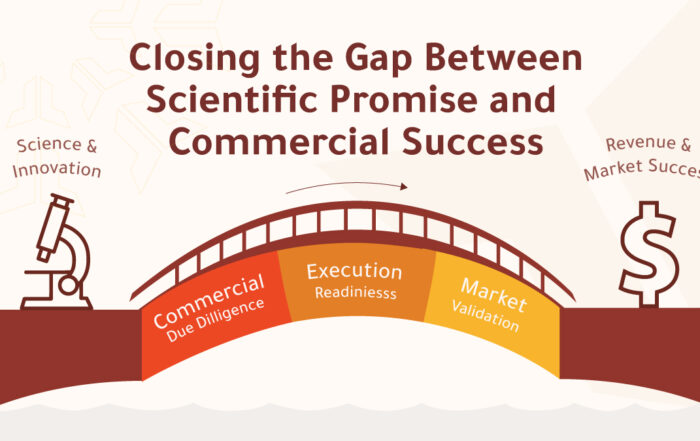
Modern commercial due diligence must be integrated and execution-focused, examining how strategy translates into delivery.
Key questions include:
Evaluated together, these factors provide a realistic view of execution risk, capital requirements, and time-to-revenue.
Data-Driven Market Validation in High-Uncertainty Environments
Biotech development timelines now routinely exceed 7–10 years, while payer scrutiny on pricing and access continues to intensify. As a result, commercial decisions must be evidence-led, not assumption-driven.
High-quality CDD incorporates:
This approach replaces single-point forecasts with resilient, scenario-tested assumptions.
Commercial Due Diligence as a Value Creation Tool
When executed rigorously, CDD becomes a strategic planning engine. It informs launch sequencing, resource allocation, and milestone-based capital deployment – often accelerating time-to-launch by 6–12 months.
As biotech funding becomes more selective, commercial credibility is expected earlier. Commercial due diligence is no longer optional; it is foundational to building investment-grade biotech assets.
Turning Commercial Insight into Executable Growth
Thaver operates at the intersection of strategy, market validation, and execution readiness. Through rigorous commercial due diligence and hands-on execution support, Thaver helps biotech companies and investors convert scientific insight into operationally credible growth—reducing execution risk while accelerating commercial outcomes.